

Introduction
Hot-temperature crops and greenhouse microclimate
Nutrient uptake in smart greenhouse crops
Effects of nutrient uptake variability
Monitoring techniques for nutrient uptake
Control strategies for nutrient uptake in smart greenhouses
Automated control systems represent a major advancement in mitigating nutrient variability.
Data-driven control and safety constraints
Challenges and future perspectives
Conclusions
Introduction
Hot-temperature crops production plays a critical role in ensuring a stable, year-round supply of vegetables and fruits, particularly in regions where outdoor cultivation is increasingly constrained by extreme heat, drought, and climate variability (Farvardin et al., 2024). As global temperatures rise and traditional production zones become progressively hotter and drier, greenhouse cultivation has emerged as a viable and increasingly essential alternative for sustaining agricultural productivity (Farvardin et al., 2024; Soussi et al., 2022). Controlled-environment agriculture (CEA) enables growers to regulate temperature, humidity, radiation/light intensity, and water supply, thereby mitigating climatic risks and supporting consistent crop yields (Islam et al., 2024a; Kabir et al., 2023). This production strategy is especially important for heat-sensitive crops such as tomato, which are highly susceptible to thermal stress under open-field conditions but can achieve high productivity and quality when cultivated in controlled environments.
The rapid global expansion of greenhouse agriculture highlights the growing importance in modern food systems (Islam et al., 2025; Kabir et al., 2023). The commercial greenhouse market is projected to increase from approximately USD 47.6 billion in 2024 to USD 66.8 billion by 2029, driven by rising food demand, climate change adaptation, and increasing investment in high-technology production systems (Fuentes-Peñailillo et al., 2024). Advances in automated climate control, sensor-based monitoring, and artificial intelligence (AI)-supported management platforms are transforming greenhouses into highly efficient, data-driven production systems (Fuentes-Peñailillo et al., 2024; Kaya, 2025). These innovations not only improve crop productivity and resource-use efficiency, but also promote technological development and employment across both developed and developing economies (Kaya, 2025). In arid, semi-arid, and tropical regions, greenhouse systems are increasingly relied upon to sustain vegetable and fruit production despite high ambient temperature, intense solar radiation, and limited freshwater availability (Soussi et al., 2022).
Despite these technological advances, effective nutrient management remains one of the most critical challenges in hot-temperature crops greenhouse production. Plant nutrient uptake is strongly influenced by temperature, water availability, and plant physiological status (Islam et al., 2024a; Soussi et al., 2022). Even minor imbalances can reduce yield, compromise quality, and weaken resilience (Argento et al., 2024; Kumar et al., 2025). Elevated temperatures and high vapor pressure deficit (VPD) accelerate evapotranspiration and disrupt water-nutrient transport, often restricting uptake of immobile nutrients such as calcium and magnesium which rely on stable xylem transport, however; increased transpiration may enhance mass flow of mobile nutrients such as nitrate and potassium (Costa et al., 2019; Mishra et al., 2023). Root-zone temperatures above optimal levels can impair membrane permeability, reduce enzymatic activity, and alter rhizosphere microbial processes involved in nutrient mineralization, thereby decreasing nutrient uptake efficiency (Sardans et al., 2023). Conventional nutrient supply practices, which often rely on fixed nutrient formulations and static application schedules, are frequently inadequate in hot greenhouse environments characterized by rapid and continuous microclimatic fluctuations (Argento et al., 2024). As a result, conventional nutrient management practices based on fixed nutrient formulations and static application schedules are often inadequate under hot-temperature crops greenhouse conditions characterized by rapid and continuous microclimatic fluctuations.
Nutrient dynamics in high-temperature greenhouse environments are complex due to strong interactions among microclimate conditions, water fluxes, substrate properties, and plant physiology (Gruda et al., 2025). Elevated air temperatures increase evapotranspiration, accelerating water movement through substrates and intensifying nutrient transport toward the root zone. However, this often leads to uneven moisture distribution and fluctuating electrical EC, particularly under drip irrigation systems. High vapor pressure deficit (VPD), commonly observed in hot greenhouses, promotes rapid transpiration and may disrupt ion transport mechanisms within the plant, resulting in nutrient imbalance even when nutrient concentrations in the supplied solution appear adequate.
Thermal stress directly affects root physiology and rhizosphere processes. Root-zone temperatures above 30°C impair membrane permeability, reduce enzyme activity, and alter microbial communities responsible for nutrient mineralization. These effects decrease nutrient uptake efficiency and increase the risk of deficiencies in immobile elements such as calcium and magnesium. Disorders such as blossom-end rot in tomato or tip burn in leafy vegetables frequently occur under these conditions (Mishra et al., 2023). Together, these factors reduce the effectiveness of traditional fertilization approaches and highlight the need for adaptive, responsive nutrient management strategies tailored to high-temperature environments.
Within this context, the concept of nutrient variability has gained increasing attention. Nutrient variability refers to the spatial and temporal fluctuations in nutrient concentration, availability, and plant uptake within greenhouse production systems (Islam et al., 2024a; Kabir et al., 2023). Spatial variability may arise from non-uniform irrigation, heterogeneous substrate properties, and microclimatic gradients caused by differences in shading, ventilation, and cooling efficiency (Costa et al., 2019). Even within a single greenhouse compartment, variations in airflow and temperature can generate localized hot spots that alter transpiration rates and root-zone nutrient concentrations. Temporal variability reflects dynamic changes driven by crop growth stage, diurnal climate cycles, irrigation events and progressive nutrient accumulation or depletion in the root zone (Reza et al., 2025). Nutrient demand varies substantially throughout the crop life cycle, with higher requirements during periods of rapid vegetative growth or fruit development. Under hot conditions, these temporal dynamics are further amplified by rapid environmental fluctuations, making it difficult to synchronize nutrient supply with plant demand. Together, these factors reduce nutrient-use efficiency, increase production costs, and compromise sustainability.
Given the global expansion of greenhouse production into warmer climates has made the understanding and management of nutrient variability an essential scientific and practical priority (Savvas et al., 2023). In recent years, the range of available monitoring and control tools has expanded considerably. Conventional laboratory-based analyses of nutrient solutions and plant tissues remain important for calibration and diagnosis, but are limited by low temporal resolution and labor-intensive operation. In contrast, advanced sensing technologies, including EC and pH probes, ion-selective electrodes, optical sensors, imaging systems and thermal cameras, enable continuous and in situ monitoring of nutrient-related parameters. When integrated with internet of things (IoT) networks, these sensors generate high-frequency data streams capable of capturing both spatial and temporal variability within greenhouse systems (Bicamumakuba et al., 2025).
Beyond monitoring, modern greenhouse nutrient management is increasingly moving toward automation, feedback regulation, and predictive decision-making. Precision nutrient supply systems, automated controllers, AI-driven decision support systems, and emerging digital twin frameworks offer new opportunities to dynamically adjust nutrient supply in response to real-time environmental and crop conditions (Islam et al., 2024b; Yang et al., 2025). These approaches shift nutrient management from reactive correction toward proactive optimization, with the potential to improve nutrient-use efficiency, reducing waste, and improving crop performance under heat stress. However, their practical implementation remains constrained by sensor calibration challenges, data integration complexity, high initial costs, and limited accessibility for small- and medium-scale growers.
It is essential to clearly examine the mechanisms underlying nutrient variability in hot-temperature crops greenhouse systems and critically evaluate current technologies for monitoring and controlling this variability. Particular attention is given to the interactions among greenhouse microclimate, root-zone processes, plant nutrient uptake, sensing technologies, and advanced control strategies. Based on this, the review aimed to provide a detailed assessment of nutrient variability and the technologies available to monitor and control for hot-temperature crops greenhouse.
Hot-temperature crops and greenhouse microclimate
Greenhouses for hot temperature crops are widely used to cultivate high-value crops, particularly tomato (Solanum lycopersicum), sweet pepper (Capsicum annuum), cucumber (Cucumis sativus), and melon (Cucumis melo) (Yadav and Kumar, 2024). These crops are mainly favored for their strong market demand, short growth cycles, and responsiveness to nutrient supply and environmental control management systems (Yadav and Kumar, 2024). In many arid and semi-arid regions, greenhouse cultivation allows growers to extend the production season, reduce pest pressure, and achieve higher water-use efficiency compared with open-field systems. Nevertheless, maintaining suitable growing conditions in high-temperature environments presents significant technical and physiological challenges for plants.
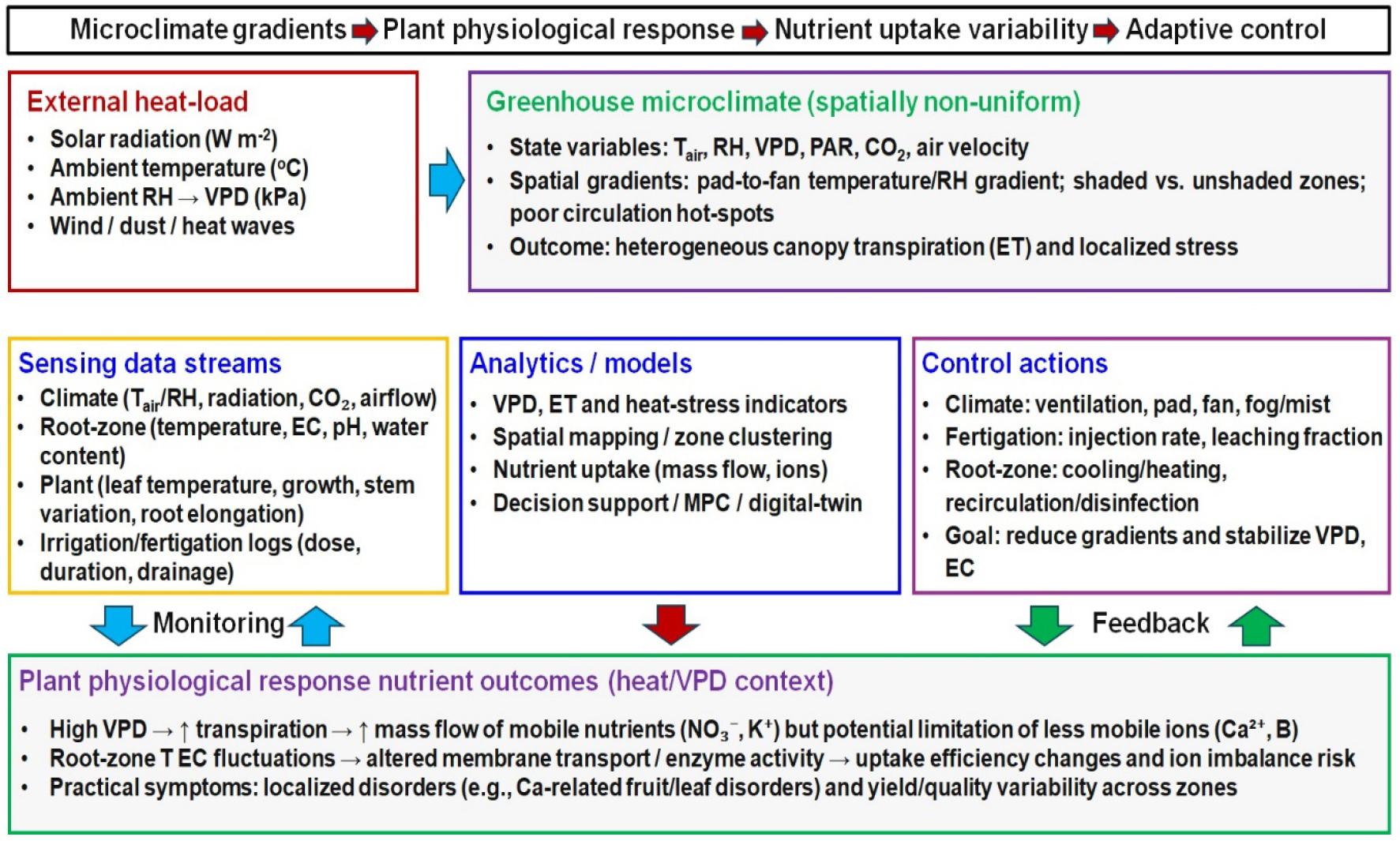
Hot-temperature crops greenhouses are characterized by elevated air temperatures often exceeding 35°C), high solar radiation levels (>800 Wm⁻2), and substantial evaporative demand (Costa et al., 2019). These conditions often result into low relative humidity (20-40%) and high VPD, which accelerate evapotranspiration (ET), leading to rapid water and nutrient fluxes within the plant-root zone system (Costa et al., 2019; Yusuf et al., 2025). At the same time, microclimate conditions are rarely uniform: differences in shading, airflow, and cooling efficiency which generates spatial gradients in temperature and humidity (Yusuf et al., 2025). Poor ventilation or uneven air circulation can further exacerbate local heat accumulation and water stress, thereby amplifying spatial heterogeneity in nutrient concentration and root-zone EC (Reza et al., 2025). Advanced cooling methods such as pad-and-fan systems, misting, and shading nets are commonly used to reduce canopy temperature, yet their uneven operation may create micro-zones of differing water and nutrient availability (Yusuf et al., 2025). Hence, understanding these microclimate gradients is essential for effective nutrient monitoring and control for hot-temperature crops. Multiple studies demonstrate the effectiveness of cooling techniques, such as the shading nets reduced leaf temperature by 4°C and increased photosynthesis by 94% and misting mitigated midday photosynthetic depression (Balliu et al., 2021). Fig. 1 shows a conceptual framework for hot-temperature crops greenhouse monitoring and control system.
Under elevated temperatures, plant nutrient uptake is influenced by both physiological and physicochemical factors (Mishra et al., 2023). Increased transpiration enhances the mass flow of nutrients such as nitrate and potassium to the roots, but can simultaneously restrict uptake of less mobile elements like calcium, magnesium, and boron thereby increasing the risk of imbalances (Costa et al., 2019; Mishra et al., 2023). In addition, root-zone temperatures above 30°C can impair root membrane permeability and enzyme activity, leading to reduced nutrient absorption efficiency and ion imbalance (Sardans et al., 2023). Heat stress also triggers oxidative and osmotic stress within plant tissues, altering the synthesis of proteins and metabolites involved in nutrient transport (Jayara et al., 2023; Ashrafi et al., 2020). As a result, calcium-related disorders such as blossom-end rot in tomato and tip burn in lettuce become more prevalent under high VPD and fluctuating root-zone EC (Reza et al., 2025; Jayara et al., 2023). In cucumbers and melons, excessive temperature can disrupt nitrogen assimilation, decreasing leaf chlorophyll concentration and photosynthetic performance. Collectively, these responses demonstrate that nutrient uptake under high-temperature greenhouse conditions is highly dynamic, governed by complex interactions among microclimate, irrigation, substrate properties, and plant physiology. As a result, maintaining uniform nutrient availability and minimizing variability require integrated approaches combining precise environmental control, adaptive nutrient supply scheduling, and real-time monitoring.
Nutrient uptake in smart greenhouse crops
Nutrient uptake in hot-climate greenhouse production systems arises from the complex interactions among microclimatic conditions, substrate properties, irrigation management, and plant physiological dynamics (Sardans et al., 2023; Soussi et al., 2022). These factors collectively determine the spatial and temporal distribution of nutrients within the root zone and plant tissues. In high-temperature environments, even small fluctuations in temperature, humidity, or water availability can cause significant differences in nutrient uptake, leading to uneven growth patterns and variable crop quality.
Nutrient uptake in hot-temperature crops under hot greenhouse conditions represents a multifaceted challenge linked to microclimate dynamics, crop physiology, and management practices. The evidence suggests nutrient uptake is a multifaceted challenge requiring sophisticated, adaptive agricultural management strategies (Mishra et al., 2023). Addressing these interactions requires integrated monitoring and control systems capable of detecting and responding to spatial and temporal fluctuations (between greenhouse zones) in real time.
High air temperature and low relative humidity increase evapotranspiration rates, intensifying water and nutrient flow through the plant, while this can temporarily enhance nutrient transport to aerial parts, prolonged exposure to high VPD often causes stomatal closure and reduced ion uptake (Yusuf et al., 2025; Jayara et al., 2023). Elevated root-zone temperature (>30°C) can further impair root permeability, enzyme function, and microbial activity involved in nutrient mineralization (Sardans et al., 2023). Plants under thermal stress may experience deficiencies in immobile nutrients such as calcium, boron, and iron despite their adequate presence in the substrate or nutrient solution
Ventilation strongly affects the uniformity of temperature, humidity, and CO2 distribution inside greenhouses, Inadequate or uneven air movement leads to localized heat accumulation (hot spots) and humidity gradients that alter transpiration and nutrient absorption patterns (Singh et al., 2022). Studies have shown that plants positioned near vents or cooling pads often display higher growth rates and nutrient concentrations than those in central or poorly ventilated zones thus, heterogeneous airflow can induce spatial nutrient variability even within small-scale greenhouse compartments (Singh et al., 2022; Costa et al., 2019).
The physical and chemical characteristics of the growing medium greatly influence nutrient dynamics. Substrates with high porosity and low water-holding capacity tend to cause rapid nutrient leaching and fluctuations in EC, while organic or coco peat-based media buffer nutrient availability but may accumulate salts under high evaporative demand (Reza et al., 2025; Kabir et al., 2023). Under heat stress, differences in moisture retention among substrates become more pronounced, resulting in uneven nutrient concentrations between upper and lower root layers, additionally, the cation exchange capacity (CEC) of substrates affects nutrient binding and release, further contributing to variability (Mishra et al., 2023). Table 1 summarizes the influence of elevated temperatures on EC, pH stability, ion mobility, substrate moisture retention, cation exchange capacity, and ventilation, highlighting their impacts on nutrient variability.
Table 1.
Effect of temperature related effects on nutrient solution dynamics in greenhouse cultivation.
| Factor | Changes | Impact | Reference |
| Electrical conductivity (EC) | Rapid water loss, concentrates salt, raising root zone EC | Localized salt accumulation, osmotic stress risk | Yusuf et al. (2025); Minhas et al. (2020) |
| pH stability | Increased microbial activity, accelerate pH shifts | Alters solubility of micronutrients, uneven uptake across zones | Mishra et al. (2023) |
|
Ion mobility (NO₃⁻, K⁺, Ca2⁺) | Faster transpiration,; prolonged heat causes stomatal closure. | Nutrient leaching,; calcium deficiency | Jayara et al. (2023); Sardans et al. (2023) |
| Water retention in substrate | High evapotranspiration | Uneven nutrient concentrations | Reza et al. (2025); Kabir et al. (2023) |
| Cation exchange capacity (CEC) | Accelerates ion exchange, salt buildup | High nutrient variability, risk of salinity accumulation | Mishra et al (2023) |
| Ventilation and airflow | Creates hot spots, humidity gradients | Spatial variability, heterogeneous nutrient absorption | Singh et al. (2022); Costa et al. (2019) |
Different crops exhibit varying nutrient uptake kinetics and root architectures, influencing their growth contribution. For instance, tomatoes and peppers develop deeper root systems and higher potassium demand during fruiting, while cucumbers and melons show shallower root zones with rapid nitrogen uptake in vegetative stages (Islam et al., 2024a). The growth stage and canopy coverage also modify the transpiration rate, which directly impacts nutrient flux, as the canopy expands, shading and humidity gradients emerge, leading to localized differences in root-zone drying and nutrient replenishment rates (Islam et al., 2025; Kabir et al., 2023).
Irrigation methods and evapotranspiration rates (water, fertilizer application, etc.). Irrigation and nutrient supply practices are key determinants of nutrient uniformity, most commonly drip systems are used because they are efficient, but can produce non-uniform wetting patterns if emitter spacing or pressure regulation is inconsistent (Thomas et al., 2024). High temperatures and evapotranspiration (ET) accelerate water loss from substrates, concentrating salts and increasing EC near the root surface (Yusuf et al., 2025; Minhas et al., 2020). At the same time, over-irrigation can lead to nutrient leaching, particularly of nitrate and potassium. The timing, frequency, and volume of irrigation relative to plant water demand therefore have a direct effect on both temporal and spatial nutrient variability.
Effects of nutrient uptake variability
Uneven nutrient distribution leads to heterogeneous growth, with some plants exhibiting vigorous development while others suffer from deficiency symptoms (de Bang et al., 2021). This spatial inconsistency reduces overall yield potential and marketable quality, for instance, calcium or boron deficiencies caused by localized EC stress can result in fruit disorders such as blossom-end rot in tomato or misshapen fruits in cucumber. Variability in nitrogen availability also influences leaf chlorophyll content, affecting photosynthetic efficiency and carbohydrate allocation (Xiong et al., 2015).
Nutrient-imbalanced plants are generally less resilient to abiotic and biotic stresses. Under high-temperature conditions, nutrient-deficient tissues show weakened cell walls and impaired metabolic activity, increasing vulnerability to pathogens and physiological disorders (Sewelam et al., 2021). Deficiency in micronutrients such as zinc and iron can exacerbate oxidative stress under heat exposure, leading to premature senescence or reduced recovery from thermal injury (Sarwar et al., 2019). In high-temperature greenhouse environments, this challenge is combined with elevated evapotranspiration which alters nutrient fluxes and increases electrical conductivity (EC) variability. Sensor technologies such as EC and pH probes, essential for monitoring root-zone conditions, are themselves influenced by temperature fluctuations, potentially producing inaccurate readings if not properly calibrated. Thus, the reliability of nutrient monitoring under thermal stress depends not only on plant physiology but also on the robustness of sensor performance in hot temperature crop greenhouse conditions (Bhujel et al., 2021).
Nutrient uptake decreases fertilizer-use efficiency (FUE), as some areas receive excess nutrients while others remain deficient (Jayara et al., 2023). Over-supplied zones often experience nutrient accumulation and osmotic stress, while under-supplied zones restrict plant growth. This imbalance not only wastes resources but also disrupts the synchronization between nutrient supply and plant demand, making precise nutrient supply management more difficult (Ashrafi et al., 2020).
Non-uniform nutrient application and over-fertilization under high evapotranspiration can result in nutrient leaching into drainage water, particularly in hydroponic or soilless systems, nitrate leaching poses environmental risks to groundwater, while accumulation of salts such as sodium or chloride degrades substrate quality over time (Li et al., 2018). In arid regions where greenhouse effluents are often reused or discharged into limited water bodies, these nutrient losses contribute to environmental pollution and reduce system sustainability (Abd-Elaty et al., 2022). Table 2 outlines the consequences of uneven nutrient distribution, including growth heterogeneity, reduced stress tolerance, lower fertilizer-use efficiency, environmental pollution, and long-term system instability.
Table 2.
Effects of nutrient uptake on crop growth, stress response, resource efficiency, and environmental sustainability in greenhouse systems.
| Effect Category | Key Impacts | Mechanisms | References |
| Growth heterogeneity and yield reduction | Uneven plant development, reduced yield | Deficiencies of Ca and B cause blossom-end rot in tomato and cucumber fruits; variable N affects chlorophyll content and photosynthesis | de Bang et al. (2021); Xiong et al. (2015) |
| Reduced stress tolerance | Higher susceptibility to heat stress, pathogens, and physiological disorders | Zn and Fe deficiencies increase oxidative stress; weakened cell walls under nutrient stress increase disease vulnerability | Sewelam et al. (2021); Sarwar et al. (2019) |
| Lower fertilizer-use efficiency (FUE) | Nutrient wastage and poor synchronization with crop demand | Elevated ET accelerates osmotic stress, limited growth | Jayara et al. (2023); Ashrafi et al. (2020) |
| Environmental pollution | Nutrient leaching and salinity buildup | Contaminates groundwater, Na⁺ and Cl⁻ leaching and degrades substrates | Li et al. (2018) |
| Reduced system sustainability | Long-term degradation of water and substrate quality | Increases environmental load and limits reuse potential | Abd-Elaty et al. (2022) |
| Overall system instability | Decline in productivity and crop quality under heat stress | Elevated temperature affects nutrient imbalance and crop performance | Mishra et al. (2023) |
Monitoring techniques for nutrient uptake
Effective monitoring of nutrient uptake in hot-temperature crops environments is fundamental to achieving precision nutrient management and maintaining optimal crop performance (Reza et al., 2025). Accurate and early detection of nutrient imbalances enables growers to adjust nutrient supply strategies, reduce nutrient waste, and mitigate stress effects associated with high temperatures. Monitoring approaches can be broadly categorized into conventional analytical methods, sensor-based systems, and remote/imaging technologies, with recent innovations incorporating IoT connectivity and AI for data integration and predictive control (Catota-Ocapana et al., 2025).
Traditional nutrient monitoring in greenhouse systems typically relies on periodic sampling and laboratory analysis of growing media, nutrient solutions and plant tissues (Langenfeld et al., 2022). A key limitation of conventional analyses is their low temporal resolution: they provide snapshot measurements that may miss rapid fluctuations driven by diurnal temperature patterns, evapotranspiration peaks, and irrigation events. As a result, while conventional methods remain essential for calibration and validation of automated systems, they are less suitable for real-time control in dynamic, high-temperature greenhouse conditions.
In greenhouse production systems, conventional nutrient monitoring primarily relies on solution sampling of leachate or root-zone extracts to determine electrical conductivity (EC), pH, and ion concentrations using laboratory-based spectroscopic or chromatographic techniques. These methods provide accurate quantitative assessments of nutrient composition; however, they are labor-intensive, time-consuming, and require specialized analytical facilities (Langenfeld et al., 2022). In addition, leaf tissue analysis of diagnostically relevant organs, such as young fully expanded leaves, is widely used to evaluate plant nutritional status and to diagnose nutrient deficiencies or toxicities for longer-term nutrient management.
Water use efficiency (WUE) is commonly defined as the ratio of dry biomass production to the total volume of water transpired and is typically calculated by dividing the total dry mass at harvest by the cumulative water supplied to the root zone (Hatfield and Dold, 2019). WUE is governed by both the atmospheric driving gradient for transpiration and stomatal conductance, and it is closely linked to tissue nutrient concentrations and nutrient solution composition.
Although solution sampling and tissue analysis remain the standard approaches for nutrient assessment and for calibrating automated monitoring systems, these methods provide only discrete, snapshot measurements. As a result, they are poorly suited for capturing rapid fluctuations in nutrient availability associated with diurnal temperature variations, irrigation events, or transient stress conditions. Their limited temporal resolution restricts their applicability for real-time decision-making in dynamic, high-temperature greenhouse environments, where continuous monitoring is increasingly required to optimize nutrient and water management strategies (Langenfeld et al., 2022).
Recent advancements in sensor technology have enabled continuous, in-situ monitoring of nutrient and environmental parameters within greenhouse systems. Sensor-based approaches are essential for detecting spatial and temporal variability that cannot be captured by conventional sampling methods. Ion-selective electrodes (ISEs) allow direct measurement of specific nutrient ions, such as nitrate (NO3⁻), potassium (K+), calcium (Ca2+), and phosphate (PO43⁻), in nutrient solutions (Reza et al., 2025; Kitazumi, 2022). These sensors provide real-time ion concentration data, enabling immediate adjustment of nutrient supply schedules (Silva et al., 2024). However, their performance is sensitive to temperature fluctuations and ionic interference, necessitating frequent calibration and maintenance, particularly in high-temperature greenhouse environments.
Electrical conductivity (EC) and pH sensors are among the most widely deployed tools in greenhouse nutrient management systems. EC serves as an indicator of total dissolved ions, reflecting overall salinity and nutrient concentration, while pH strongly influences nutrient availability and root absorption efficiency (Langenfeld et al., 2022). Continuous EC and pH monitoring provides essential feedback for maintaining nutrient balance; however, it cannot distinguish individual ion species. In hot-temperature crops greenhouses, EC variations are closely linked to evapotranspiration and water uptake rates, making these sensors critical for adaptive nutrient control strategies. To ensure reliable use of these sensors in closed-loop nutrient management, minimum calibration and estimation procedures are required. Ion-selective electrodes and EC/pH probes must be periodically calibrated against laboratory standards to correct for temperature-induced drift, ionic interference, and contamination. State estimation techniques, such as Kalman filtering or moving-average smoothing, can reduce noise and compensate for missing data, thereby improving the stability of nutrient measurements under fluctuating thermal conditions. Sensor fusion — combining ion-specific electrodes, EC/pH probes, and optical indices — further enhances robustness by integrating complementary signals across different spatial and temporal scales. This instrumentation-estimation framework transforms raw sensor data into reliable state variables for control algorithms, reducing the risk of inaccurate nutrient dosing and enabling more resilient closed-loop operation in hot-temperature crops greenhouse environments.
Optical sensing technologies, including chlorophyll meters, fluorescence sensors, and multispectral or hyperspectral cameras, offer non-destructive assessment of plant nutrient status. Soil plant analysis development (SPAD) meter quantifies leaf chlorophyll content, which correlates strongly with nitrogen concentration (Reza et al., 2025). Fluorescence sensors evaluate photosystem efficiency and can detect early stress responses before visible symptoms appear. Multispectral and hyperspectral sensors capture reflectance data across multiple wavelengths, enabling the estimation of multiple nutrient deficiencies simultaneously (Zhang et al., 2022a). These optical tools are particularly valuable under heat stress conditions, as they can detect changes in pigment composition, leaf water content, and canopy temperature associated with nutrient imbalances.
The integration of remote sensing platforms, such as unmanned aerial vehicles (UAVs) and fixed imaging systems, has significantly enhanced spatial monitoring of greenhouse crops (Han, 2024). These technologies enable non-destructive, high-resolution data acquisition over large cultivation areas, facilitating precise assessment of crop growth, canopy structure, and physiological status. UAV-mounted multispectral, hyperspectral, and thermal cameras capture spectral signatures used to compute vegetation indices, which provide insights into plant vigor, nutrient distribution, and water stress (Jayasuriya et al., 2024; Roma et al., 2023).
UAV-based systems can identify heterogeneous nutrient zones resulting from uneven microclimate conditions or irrigation distribution. Operating at low altitudes allows spatial resolutions of approximately 1–10 cm per pixel, enabling the detection of uptake variability in crop performance, pest infestations, and nutrient deficiencies (Jayasuriya et al., 2024). In addition, UAV-based photogrammetry supports the generation of three-dimensional (3D) canopy models, providing geometric parameters such as plant height and canopy volume (Yang et al., 2025). Despite challenges related to flight regulations, battery limitations, and data processing complexity, UAV platforms remain essential for rapid and scalable crop surveillance. Thermal imaging further complements these datasets by identifying canopy temperature anomalies associated with stomatal closure and reduced transpiration, which are often early indicators of nutrient imbalance or water stress (Page et al., 2018; Kumar et al., 2025). Although UAV applications are more common in open-field systems, their use in large-scale greenhouse complexes is increasing. Remaining challenges, including light interference, calibration requirements, and spatial resolution constraints, can be mitigated through controlled illumination and advanced image-processing techniques (Von Bueren et al., 2015).
Recent developments in smart greenhouse technology emphasize the integration of sensor networks, wireless communication, and AI-based analytics to create adaptive monitoring systems (Bersani et al., 2022). Internet of Things (IoT)-based sensor frameworks enable distributed deployment of EC, pH, temperature, humidity, and nutrient sensors for real-time data acquisition (Islam et al., 2022). These data are transmitted wirelessly to centralized platforms or cloud servers for continuous analysis and visualization. Such systems provide high spatial resolution of nutrient and environmental conditions and can automatically trigger control responses, including nutrient dosing adjustments and cooling system activation (Visconti et al., 2020). In hot-temperature crops greenhouse conditions, IoT-based monitoring reduces manual intervention and improves precision by linking environmental fluctuations with nutrient dynamics.
Machine learning (ML) and AI models are increasingly applied to interpret the complex datasets generated by sensor and imaging systems (Masson, 2024). Algorithms such as random forests, neural networks, and support vector machines can predict nutrient deficiencies and EC variations based on environmental parameters and plant reflectance indices (Zhang et al., 2022b). AI integrated system facilitate proactive nutrient management by optimizing nutrient supply schedules rather than relying on reactive corrections. When integrated with IoT-based data streams, these models form the foundation of autonomous greenhouse nutrient monitoring systems capable of operating under highly variable temperature and humidity conditions (Bunpalwong et al., 2023).
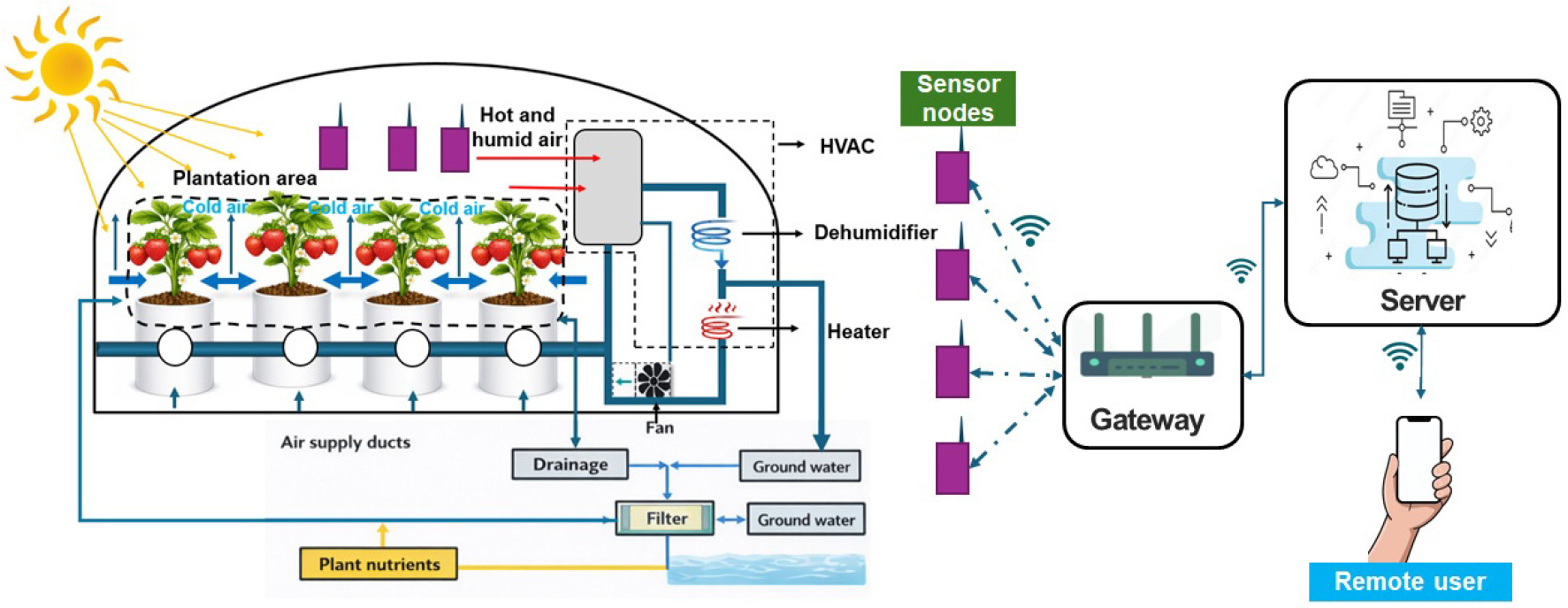
Nutrient monitoring in hot-temperature crops greenhouses has evolved from periodic manual sampling to real-time, data-driven sensing and analysis (Hosny et al., 2025). Table 3 summarizes key parameters, advantages, and limitations of conventional analyses, sensor-based systems, imaging platforms, and integrated AI-IoT approaches used to monitor nutrient dynamics. The combined use of IoT, remote sensing, and AI provides unprecedented capability to detect, interpret, and manage nutrient variability using sensor nodes installed within the greenhouse to detect environmental and nutrient variability as depicted in Fig. 2. This system addresses rapid diurnal variability (minutes to hours) in EC, pH, temperature, and humidity at the multi-zone spatial scale. Minimum recommended indicators include EC and pH, which are continuously monitored to detect nutrient and environmental fluctuations. With heating, cooling, dehumidifying, and uniform air circulation within the greenhouse, environmental conditions are kept in a required ambient crop growth environment (Maraveas and Bartzanas, 2021).
Table 3.
Summary of monitoring techniques for nutrient variability in hot-temperature crops greenhouse systems
| Monitoring technique | Key parameters | Application period | Application level | Advantages | Limitations | References |
| Conventional laboratory analysis | EC, pH, ion concentrations, tissue nutrients | Days to weeks | Root-zone | High accuracy, reliable for calibration and validation | Labor-intensive, time-consuming, low resolution, not real-time | Langenfeld et al. (2022) |
| Water use efficiency (WUE) assessment | Dry biomass, water supplied | Seasonal to harvest scale | Whole-plant level | Integrates water, nutrient and plant interactions, useful for long-term evaluation | Not real-time, influenced by environmental variability | Hatfield and Dold (2019) |
| Ion selective electrodes (ISEs) | NO3⁻, K+, Ca2+, PO43⁻ | Minutes to hours | Root-zone | Real-time, ion-specific monitoring, immediate nutrient adjustment | Sensitive to temperature and ionic interference, requires frequent calibration | Kitazumi (2022); Silva et al. (2024) |
| EC and pH sensors | Total dissolved ions, acidity | Minutes to hours | Root-zone | Continuous monitoring; simple, widely used | Cannot distinguish individual ions | Langenfeld et al. (2022) |
| Optical sensors | Chlorophyll, photosystem efficiency, reflectance indices | Hours to days | Leaf/canopy | Non-destructive, early stress detection, multi-nutrient estimation | Indirect measurement, affected by lighting conditions | Gholizadeh et al. (2017); Zhang et al. (2022a) |
| UAV and fixed imaging systems | Vegetation indices, canopy temperature, 3D structure | Days to weeks | Wide canopy | High spatial resolution, large-area coverage, heterogeneity | Regulatory limits, battery life, data processing complexity, cost | Han (2024); Roma et al. (2023) |
| Thermal imaging | Canopy temperature | Minutes to hours | Leaf/canopy | Detects transpiration and stomatal stress early | Influenced by environmental conditions | Page et al. (2018); Kumar et al. (2025) |
| IoT-based sensor networks | EC, pH, temperature, humidity, nutrients | Continuous | Multi-zone | Real-time, automated, high spatial resolution, remote access | Requires infrastructure, calibration challenges | Bersani et al. (2022); Islam et al. (2022) |
| AI, ML-based decision systems | Multisensor and imaging data | Continuous to seasonal | Multi-zone | Predictive control, proactive management | Data dependency, model complexity | Zhang et al. (2022b); Bunpalwong et al. (2023) |
| Integrated monitoring systems | All nutrient parameters | Continuous | Multi-zone | Real-time, scalable, adaptive | Cost, interoperability, calibration | Hosny et al. (2025); Maraveas and Bartzanas, 2021) |
Control strategies for nutrient uptake in smart greenhouses
Building on calibrated and fused sensor data, control strategies must address how these reliable state estimates are used to manage nutrient variability under hot-temperature crops greenhouse conditions. By ensuring that observation errors are minimized, closed-loop systems can more effectively respond to rapid evapotranspiration, fluctuating root-zone conditions, and heterogeneous airflow. Effective control of nutrient variability in hot-temperature crops greenhouse environments requires strategies that address the fundamental system dynamics: transport delays, nonlinear feedback, strong disturbances, and sensor uncertainty. These factors are amplified under thermal stress, where rapid evapotranspiration, fluctuating root-zone conditions, and heterogeneous airflow disrupt nutrient transport and uptake. Any control system must therefore be evaluated against its ability to manage delay, adapt to nonlinear interactions, remain stable under disturbances, and compensate for sensor drift or missing data (Mishra et al., 2023; Balliu et al., 2021). This section outlines current and emerging strategies for mitigating spatial and temporal nutrient variability, focusing on irrigation and nutrient management, automated control systems, biological and agronomic interventions, and advanced digital technologies.
Irrigation and nutrient supply remain the foundation of nutrient control in greenhouse environments, drip nutrient supply scheduling is the most widely adopted method for its ability to precisely deliver water and nutrients to the root zone in greenhouse systems (Thomas et al., 2024; Fathidarehnijeh et al., 2023). Under hot conditions, frequent and finely tuned irrigation cycles are essential to offset rapid evapotranspiration and maintain stable root-zone EC, dynamic formulation systems, integrated with automated controllers, can modify nutrient ratios, EC, and pH in real time to sustain membrane stability and fruit quality (Yusuf et al., 2025; Li et al., 2018; Minhas et al., 2020). Closed-system nutrient supply, where excess solution is collected and reused, further improves efficiency by reducing water consumption and minimizing environmental pollution, though pathogen risks must be carefully managed. Scheduling decisions are often based on sensor feedback (soil moisture, EC, or plant-based indicators) or climate-driven models that estimate crop water and nutrient demand. Temperature rises typically enhance the absorption of mobile ions such as nitrate and potassium, while reducing calcium and magnesium uptake due to impaired xylem transport. Optimizing nutrient supply frequency and duration helps prevent localized salt accumulation and nutrient depletion, two major sources of spatial variability in high-temperature environments, the table below shows results that the combination control strategy had better properties than the incremental proportional-integral-derivative (PID) control strategy for automatic nutrient supply management, and it will provide a scientific basis for precise irrigation and fertilization control for crops in greenhouses (Yang et al., 2025; Kim et al., 2023).
Nutrient solution formulation adjustments include adjusting the composition of nutrient solutions according to temperature-driven changes in plant uptake. Elevated temperatures generally increase the uptake of mobile ions (e.g., nitrate, potassium) while reducing calcium and magnesium absorption due to impaired xylem transport. Dynamic formulation systems can modify the nutrient ratio, EC, and pH in response to real-time feedback from sensors or plant condition models (Silva et al., 2024; Kitazumi, 2022). For instance, higher calcium concentrations or chelated micronutrients may be required during hot periods to sustain membrane stability and fruit quality. Integrating these adjustments with automated nutrient supply controllers enhances both precision and nutrient-use efficiency (Silva et al., 2024; Reza et al., 2025). Fertilization in soilless cultivation technologies is carried out in open or closed system, in a closed system, the excess nutrient solution is collected and may be reused for fertilization (Kabir et al., 2023; Dyśko et al., 2020). Nutrient solution recirculation should be more widely implemented to reduce water consumption and to save the environment from pollution by leachates. It is also necessary to develop processing techniques, in order to utilize drainage waters for rational water consumption in agriculture. The solution leaking from the mats is more concentrated compared to the initial concentration of the nutrient solution applied for plants, the other problem in hydroponic cultivation systems is the exposure of the plants to the risk of pathogens infection, causing root and vascular system diseases (Dyśko et al., 2020).
Automated control systems represent a major advancement in mitigating nutrient variability.
Decision support systems (DSS) integrate data from environmental, crop, and nutrient sensors to guide irrigation and fertilization decisions. These platforms combine rule-based algorithms, empirical models, or AI tools to predict nutrient requirements based on temperature, humidity, and crop growth stage (Masson, 2024; Bunpalwong et al., 2023). DSS frameworks can generate recommendations for nutrient supply scheduling, nutrient concentrations, and system maintenance. When combined with remote access interfaces, they enable growers to make data-informed adjustments in real time, thereby reducing operator error and improving consistency across greenhouse zones. Closed-loop nutrient management with sensors represents the next step toward autonomous nutrient management. In these systems, real-time feedback from EC, pH, and ion-selective sensors continuously informs control units that automatically adjust nutrient dosing and irrigation flow (Catota-Ocapana et al., 2025; Langenfeld et al., 2022). The loop operates continuously, correcting deviations caused by temperature-induced fluctuations in evapotranspiration or nutrient uptake. Such feedback-controlled nutrient supply systems have demonstrated improved yield stability and reduced nutrient waste, particularly under heat stress conditions where rapid environmental changes can otherwise lead to nutrient imbalance (Fathidarehnijeh et al., 2023). Table 4 compares operational principles, control characteristics, limitations under thermal stress, and best-use cases for PID controllers, adaptive algorithms, decision support systems, fuzzy controllers, and IoT-integrated platforms.
Table 4.
Comparative evaluation of control strategies for nutrient management in hot-temperature crops greenhouses
| Technology | Operational principal | Advantages | Limitations | Best use case | References |
| Traditional PID control | Error-based proportional correction | Simple, low cost | Slow response, overshoot under heat stress | Small greenhouses | Yang et al. (2025) |
| Two-stage combination Algorithm | Multi-phase PID, adaptive turning | High precision, low overshoot | Requires calibration | Automated nutrient supply | Kim et al. (2023) |
| DSS (Rule-based/AI) | Predictive and model-driven control | Multi-factor decision making | Data-dependent | Large multi-zone systems | Yang et al. (2025) |
| Fuzzy control | Real-time feedback correction | Very accurate, low variability | Sensor maintenance | Hydroponic systems | Aisyah et al. (2025) |
| IoT Integrated Systems | Cloud-linked distributed sensing | Remote management, rapid response | High infrastructure cost | Commercial smart farms | Maraveas and Bartzanas, 2021) |
Biological and agronomic interventions complement technological solutions by directly enhancing nutrient uptake and buffering variability. Root-zone cooling systems, using cooled nutrient solutions, subsurface water circulation, or thermal exchange pipes, help maintain optimal root temperatures thereby sustaining nutrient absorption and microbial activity (typically 20-25°C for most vegetable crops) (Islam et al., 2025; Sardans et al., 2023). In certain regions with large diurnal temperature swings, mild root-zone heating can promote nutrient absorption and microbial balance. These temperature management techniques directly enhance nutrient availability and mitigate stress-related variability. For the use of growth substrates and amendments, the choice of substrate profoundly influences water and nutrient retention, aeration, and microbial colonization. In hot-temperature crops greenhouses, substrates such as coco coir, perlite, and rockwool are commonly used for their stable hydraulic properties and low salinity. Incorporating organic amendments (e.g., compost, biochar) can further improve cation exchange capacity and buffer nutrient fluctuations. Tailoring substrate characteristics to the local microclimate helps minimize spatial nutrient gradients and enhances uniform root development (Balliu et al., 2021). Microbial inoculants and biostimulants consist of biological approaches, including plant growth-promoting rhizobacteria (PGPR), mycorrhizal fungi, and biostimulants, are gaining attention as sustainable tools to improve nutrient uptake efficiency under stress (Sun and Shahrajabian, 2023). These agents enhance root growth, solubilize nutrients, and produce stress-alleviating metabolites that improve plant tolerance to heat and nutrient imbalance. Regular inoculation with beneficial microorganisms can also stabilize nutrient cycling in the rhizosphere, reducing variability over time.
In hot-temperature crops greenhouse environments, elevated evapotranspiration (ET) accelerates water loss, concentrates salts, and destabilizes electrical conductivity (EC) in the root zone. This strategy requires rapid detection of nutrient drift, precise adjustment of irrigation and dosing, and spatially adaptive control to counter localized stress. IoT-based control systems provide this capability by integrating distributed sensors, actuators, and cloud-linked platforms for real-time monitoring. Environmental and nutrient sensors (temperature, humidity, CO2, light intensity, EC, pH) continuously monitor conditions that fluctuate under heat stress. Data are transmitted wirelessly to controllers and cloud servers, where real-time signal processing and anomaly detection identify nutrient imbalances caused by temperature spikes. Actuators (pumps, fans, heating/cooling units, valves, lighting) then execute corrective actions such as adjusting nutrient concentration and irrigation frequency to balance quickly (Bersani et al., 2022; Islam et al., 2022; Kabir et al., 2023). For large greenhouses, IoT infrastructure supports multi-zone control, which is critical because microclimate variation is amplified under high temperatures. Remote management ensures rapid operator response, while automated workflows reduce human error during heat-sensitive periods (Bicamumakuba et al., 2025). Fig. 3 illustrates the architecture of an IoT-enabled zero-discharge hot temperature crops hydroponic greenhouse system designed to achieve these goals. Environmental and nutrient sensors continuously collect real-time data, which are processed for anomaly detection. Actuators such as lighting system, heating, cooling systems adjust the environment condition to the required ambient environment condition. The nutrient solution is managed through a closed-loop workflow mixing, delivery, collection of used solution, and subsequent filtration/sterilization enabling automated monitoring, notification, and stable operation while minimizing nutrient discharge. The zero-discharge design not only enhances sustainability but also strengthens resilience against heat-induced nutrient variability by maintaining consistent nutrient solution quality. This design captures continuous variability (minutes) in nutrient solution composition and root-zone EC under hot-temperature crops stress, while operating at the greenhouse-wide spatial scale. EC and pH serve as baseline indicators, complemented by ion-specific sensors for precise nutrient control.
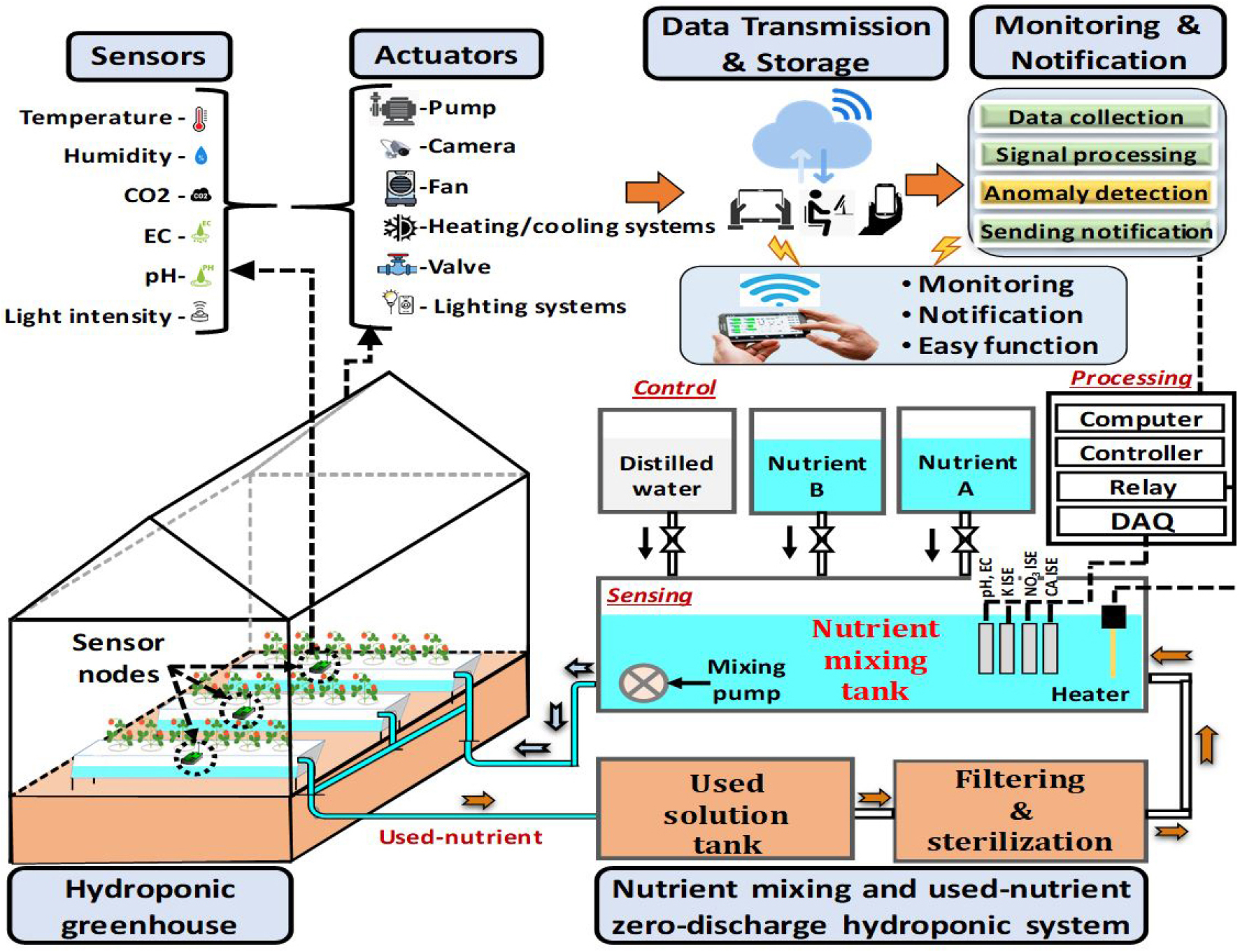
Fig. 3.
Schematic of an IoT-enabled zero-discharge hydroponic greenhouse system integrating multi-sensor monitoring, actuator-based environmental/nutrient control, wireless data transmission and storage, real-time signal processing and anomaly detection, and closed-loop nutrient solution mixing–reuse–filtration/sterilization for automated monitoring and notification
Data-driven control and safety constraints
Advanced AI- and ML-based approaches (e.g., random forests, neural networks, CNNs, RNNs) enhance predictive capacity by learning complex nonlinear interactions between microclimate and nutrient uptake. These methods directly address transport delays by forecasting nutrient demand, capture nonlinear feedback through adaptive modeling, and mitigate disturbances by integrating multi-sensor data streams. However, their reliability depends on embedding safety constraints into the control architecture. Fail-safe thresholds for EC and pH prevent oversupply during sensor failure, redundancy across multiple sensor types compensates for missing values, and confidence-weighted decision rules reduce the risk of over-reliance on uncertain predictions. By combining calibration protocols, state estimation filters, and sensor fusion with data-driven control, smart greenhouse systems evolve from reactive correction to proactive, resilient management. This instrumentation–estimation–control pipeline provides direct design implications for climate-resilient nutrient management under heat stress.
Digital twin systems, a virtual replicas of physical greenhouse operations represent a leading approach for precision and autoncomous control. In greenhouse applications, digital twins are commonly implemented first for climate, energy, and light regulation, and subsequently extended to crop- and resource-level processes such as irrigation and nutrient management (Rahman et al., 2024; Ariesen-Verschuur et al., 2022). By continuously assimilating real-time sensor measurements into mechanistic and data-driven simulation models, digital twins can reproduce nutrient dynamics, plant growth, and microclimate interactions under operational conditions. These virtual environments enable rapid evaluation of alternative nutrient-supply or climate-control strategies without interrupting production. Under high-temperature conditions, digital twins are particularly valuable for quantifying heat-stress impacts on nutrient uptake and for optimizing control set points to sustain spatial uniformity within the greenhouse (Ariesen-Verschuur et al., 2022). When coupled with AI analytics and IoT-enabled sensing/actuation networks, digital twins form an integrated platform that supports autonomous, adaptive nutrient management (Bicamumakuba et al., 2025).
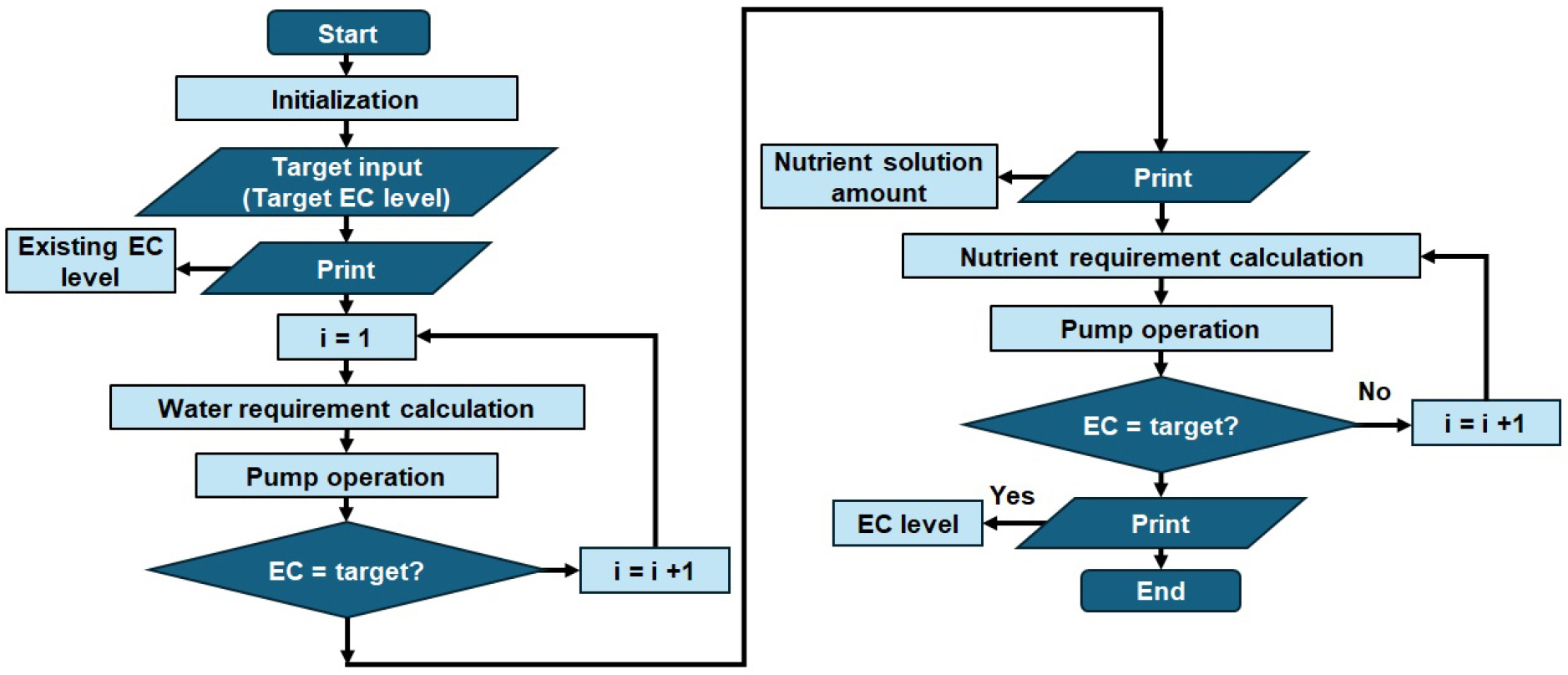
Efficient nutrient management in hydroponic systems is essential for maximizing plant growth while improving resource sustainability (Chen et al., 2022; Kabir et al., 2023). Advanced control and learning-based approaches including fuzzy logic control, artificial neural networks (ANN), convolutional neural networks (CNN), recurrent neural networks (RNN), and classical machine-learning models such as k-nearest neighbors (KNN), support vector machines (SVM), and random forests (RF) are increasingly adopted to enhance the precision and robustness of nutrient regulation. These algorithms support continuous monitoring, prediction, and closed-loop control of key variables, enabling timely adjustments that maintain nutrient availability within optimal ranges for plant development (Catota-Ocapana et al., 2025; Langenfeld et al., 2022). Fig. 4 presents a stepwise feedback-control workflow for real-time regulation of irrigation volume and nutrient-solution concentration, designed to achieve and sustain a predefined target EC level in greenhouse nutrient-supply systems. This workflow addresses short-term variability (minutes to hours) in root-zone EC and nutrient concentration at the root-zone spatial scale. The minimum recommended indicator is EC, which is continuously tracked to stabilize nutrient availability under fluctuating thermal conditions.
Fuzzy control emerged as a significant approach in hydroponic systems, facilitating improved water conservation and nutrient management (Aisyah et al., 2025). Fuzzy control application has proven to be particularly effective in automating hydroponic and aquaponic systems because it translates practical, experience-based knowledge into rule sets expressed through fuzzy variables (Lee et al., 2023). The implementation of advanced sensors and microcontrollers facilitates the creation of intelligent systems that continuously monitor and adjust growing conditions, particularly irrigation, temperature and nutrient delivery thereby ensuring an ideal environment for plant development (Aisyah et al., 2025; Lee et al., 2023). Indoor deployment aligns with the compact dimensions of the unit and the experimental objective of evaluating fuzzy logic control under stable and reproducible conditions. Different studies showed the effectiveness across various crops, including lettuce, spinach, and pakchoi, resulting in consistent and improved growth, confirming the advantages of multivariable environmental regulation for enhancing crop productivity (Aisyah et al., 2025).
Chen et al. (2022) implemented an embedded fuzzy-control approach to regulate key hydroponic solution variables pH and EC using commensal microcontrollers, demonstrating stable set point tracking under laboratory conditions, but the work remained limited by the absence of field or commercial-scale validation. Puno et al. (2020) applied fuzzy logic to a nutrient film technique (NFT) hydroponic setup and reported improved regulation of solution conditions in a controlled laboratory environment. However, the applicability is constrained by testing only under lab conditions and limited exposure to real operational disturbances. Nasution et al. (2023) extended embedded fuzzy control toward greenhouse implementation using a microcontroller unit (MCU) to manage pH and nutrient-related variables, reporting effective real-time feedback regulation, yet the evaluation did not address performance across diverse climates or high-altitude environments, which can strongly influence nutrient dynamics and control stability. In contrast, Widayat et al. (2024) emphasized deployment feasibility by using an ESP32+IoT architecture to monitor EC and temperature in a field context, showing the practicality of low-cost connected sensing and data logging; nevertheless, the system primarily provided monitoring rather than full closed-loop control (i.e., no fuzzy or automated actuation strategy). Mansoor et al. (2025) further highlighted multi-sensor and smart-sensing frameworks for precision agriculture, indicating the value of integrated measurements for decision support, but similarly reported a gap in translating monitoring platforms into fully integrated control solutions capable of autonomously adjusting nutrient delivery in real time. By transforming empirical knowledge into fuzzy rules and linguistic variables, this method allows adaptive management of critical growth parameters thus enhancing agricultural efficiency. Unlike conventional control systems that rely on static thresholds and binary switching logic, fuzzy logic provides adaptive and smooth regulation through rule-based reasoning and continuous evaluation of input variables. This approach enhances system responsiveness, prevents actuator fatigue, and improves control stability in different indoor environments. Table 5 compares representative nutrient-management control approaches by linking each strategy to the controlled variables, the operating environment, the required hardware, and the main limitations reported in prior studies. Each strategy is evaluated in terms of its methodology, controlled and observed variables, deployment setting, and reported constraints. The table highlights how fuzzy logic, IoT-enabled monitoring, and smart sensing frameworks address system dynamics such as nonlinear feedback, sensor uncertainty, and operational disturbances, while also revealing gaps in scalability and full closed-loop integration. This structured comparison provides design implications for transitioning from laboratory prototypes to robust, field-ready control systems in hot-temperature crops greenhouse environments.
Table 5.
Comparative summary of intelligent and AI-based nutrient-management control approaches.
| Control strategy | Methodology | Controlled / observed variables | Deployment setting and platform | Major constraint | Reference |
| Embedded intelligent control | Fuzzy logic controller | pH, EC | Lab-scale, Arduino interface | No real field demonstrated | Chen et al. (2022) |
| Fuzzy logic (NFT system) | NFT operation variables | Lab-scale, Arduino | Controlled laboratory conditions | Puno et al. (2020) | |
| MCU-based fuzzy control | pH and nutrient-related indicators | Greenhouse trial, MCUs | No test with high-altitude or diverse environments | Nasution et al. (2023) | |
| Connected sensing with feedback intent | IoT-enabled monitoring loop | EC, solution temperature | Field test, ESP32 + IoT connectivity | Only monitoring, no fuzzy control | Widayat et al. (2024) |
| Smart sensing framework | Multi-sensor measurements | Precision sensors | Lacks end-to-end control/actuation integration | Mansoor et al. (2025) |
Machine learning techniques involve the integration of AI within hydroponic systems has transformed nutrient management through the application of machine learning techniques. Neural networks, particularly convolutional (CNN) and recurrent neural networks (RNN), have shown promise in real-time monitoring and adjustment of crucial variables (Bicamumakuba et al., 2025; Reza et al., 2025; Kabir et al., 2023). These techniques, when combined with microcontrollers and IoT devices, provide precise and adaptive control over the growing environment, ensuring optimal conditions that promote plant health.
Recent studies show that random forest (RF) regression can substantially improve irrigation efficiency in hydroponic production, with reported water savings of approximately 80–90% in hybrid NFT and deep-water culture (DWC) systems (Kabir et al., 2023; Gillani et al., 2023). In parallel, deep-learning–based vision methods, including Faster R-CNN, have been applied to optimize nutrient delivery in tomato cultivation, supporting higher productivity through data-driven decision-making. Advances in real-time monitoring and closed-loop control further demonstrate the value of integrating AI with high-resolution sensing modalities—such as spectroscopy and digital image analysis to enable more responsive and automated hydroponic management (Islam et al. 2024c; Reza et al., 2025). Collectively, these approaches enhance nutrient-use efficiency and continuous crop monitoring, contributing to improved yield and quality while strengthening sustainability through optimized resource allocation and reduced waste (Islam et al., 2024c; Getahun et al., 2024).
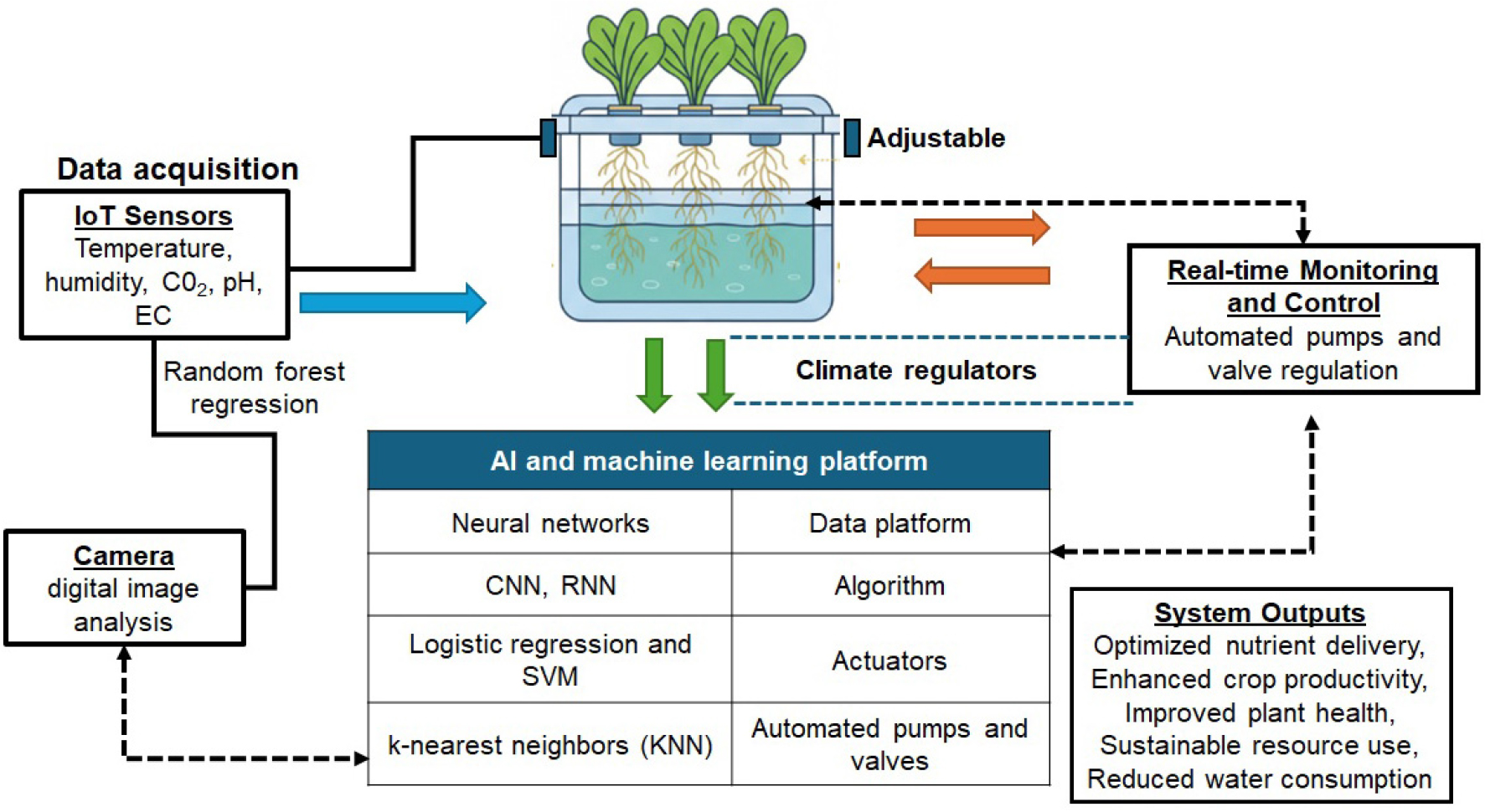
The increasing importance of machine vision technologies in hydroponic systems cannot be overstated, advanced machine learning algorithms including logistic regression and support vector machines (SVM) have effectively classified plant health states, diagnosed nutrient deficiencies, and predicted growth patterns in crops like lettuce, pepper etc. (Islam et al, 2024c; Eshkabilov and Simko, 2024). The integration of machine vision with IoT technologies allows for precise monitoring of environmental conditions, such as root status and water temperature, by analyzing morphological, color, and texture features of leaves. AI-driven decision support systems have demonstrated impressive accuracy, achieving up to 91.67% in assessing plant growth, particularly through the use of k-nearest neighbors (KNN) algorithm (Catota-Ocapana et al., 2025). Fig. 5 illustrates an integrated AI–IoT control architecture for hydroponic production in which environmental and solution variables and crop status information derived from digital image analysis are continuously acquired and processed within a machine-learning platform. Predictive and decision algorithms convert these inputs into control commands for actuators, including automated pumps, valves, and climate regulators, enabling real-time adjustment of nutrient delivery and operating conditions. This closed-loop workflow supports optimized nutrient supply, improved crop productivity and plant health, more efficient resource use, and reduced water consumption through adaptive, data-driven regulation.
Challenges and future perspectives
The challenges to effective nutrient variability control in hot-temperature crops greenhouses involve environmental limitations due to inherent exposure to strong spatial and temporal variability in air temperature, radiation, humidity and vapor pressure deficit, which complicates the maintenance of uniform nutrient availability. Localized hot spots, uneven ventilation, and fluctuating root-zone conditions disrupt nutrient uptake for less mobile elements such as calcium and magnesium. These environmental instabilities reduce the reliability of fixed nutrient management strategies and increase the risk of physiological disorders and uneven crop performance. Overcoming these requires collaborative research that bridges plant physiology, data science, and systems engineering. The integration of IoT, AI, and digital twin technologies offers a clear path forward-toward autonomous, precise, and climate-resilient greenhouse production systems capable of sustaining productivity in the face of environmental stress (Rahman et al., 2024). Although advanced sensing, IoT, and AI-based platforms offer major opportunities for real-time monitoring and control, their practical application remains constrained by several technological factors. Technical challenges (sensor calibration, reliability, integration) as one of the main limitations in precision nutrient management lies in the accuracy, calibration, and reliability of sensors used for real-time monitoring (Bicamumakuba et al., 2025; Reza et al., 2025). Sensor outputs (ISEs, EC, and pH sensors) are often sensitive to temperature fluctuations, calibration drift, ionic interference, canopy conditions and lighting variability, which can reduce data accuracy under hot greenhouse conditions which can lead to incorrect nutrient estimations especially under high heat and humidity.
Current nutrient management practices still rely on static formulations and scheduled applications that do not adequately reflect rapid changes in plant demand or microclimatic conditions as data heterogeneity and noise complicate interpretation and automation. Additionally, data transmission and storage in IoT-based systems are vulnerable to connectivity disruptions in remote agricultural regions (Mansoor et al., 2025). The lack of universal calibration protocols for nutrient sensors and the high variability of microclimatic conditions makes cross-system validation difficult, limiting scalability across different greenhouse models and geographic zones.
Despite the efficiency gains associated with controlled-environment agriculture, hot-temperature crops greenhouse production still faces important sustainability concerns. Over-fertilization, nutrient leaching, and salt accumulation can degrade substrate quality and contribute to environmental pollution in open and poorly managed soilless systems. Closed-loop and zero-discharge approaches can reduce these losses, but introduce added complexity, cost, and pathogen-management systems that are not only precise and adaptive, but also economically accessible and environmentally robust (Kabir et al., 2023; Orellana et al., 2025). While large commercial facilities in developed regions can justify these investments through yield improvements and labor savings, many farmers in hot-climate regions face capital constraints and limited technical support. Additionally, the complexity of system operation and maintenance including sensor recalibration, data interpretation, and software updates discourages wider implementation. The lack of locally adapted training programs and user-friendly decision tools further restricts adoption among less technologically experienced growers, the next generation of greenhouse management systems must advance toward fully integrated, adaptive nutrient management frameworks. Key future directions include precision nutrient supply which refers to developing adaptive nutrient supply algorithms that dynamically adjust irrigation frequency, nutrient composition, and pH based on real-time environmental and plant feedback.
Combining machine learning models with IoT-enabled sensing networks to enable predictive and self-learning control systems. These systems can forecast nutrient demands under changing thermal conditions, preventing imbalances before they occur. Data-driven decision support: Cloud-based platforms that merge sensor data, crop models, and climate forecasts will provide growers with actionable insights rather than raw measurements. Sustainable nutrient management: Integrating renewable energy sources (solar-powered pumps, wireless modules) and low-impact nutrient formulations can minimize environmental footprints while maintaining productivity. Such advancements will not only improve nutrient-use efficiency but also promote circular nutrient systems that recycle water and nutrients, reducing leaching and greenhouse effluent discharge.
Potential role in climate change adaptation, as climate change intensifies temperature extremes and water scarcity, controlled-environment agriculture (CEA) will play a pivotal role in ensuring global food security. Smart greenhouse systems equipped with AI-driven nutrient and microclimate control can serve as climate-resilient production units, maintaining yield stability even under fluctuating external conditions. Improved nutrient management in these systems can also mitigate the environmental impacts of fertilizer use, including nitrate leaching and greenhouse gas emissions. Thus, innovations in monitoring and control of nutrient variability are not only vital for operational efficiency but also for long-term adaptation and sustainability in a warming world.
Conclusions
This review highlights that greenhouse environments under high-temperature conditions strongly influence nutrient transport, availability, and plant uptake through the combined effects of elevated air temperature, intense solar radiation, high evapotranspiration demand, and pronounced microclimatic heterogeneity. These conditions can destabilize nutrient dynamics by altering electrical conductivity, pH, and ion distribution, while also disrupting the physiological processes governing nutrient absorption and translocation. The problem is further intensified by uneven irrigation, heterogeneous substrate characteristics, and localized variation in airflow, shading, and cooling efficiency, all of which contribute to substantial spatial and temporal variability in nutrient availability within greenhouse systems.
Such variability has important consequences for both crop performance and environmental sustainability. Nutrient imbalance reduces nutrient-use efficiency, increases the risk of physiological disorders, and leads to uneven crop growth, unstable yield, and reduced product quality. At the same time, inefficient nutrient management under hot conditions can increase fertilizer losses, nutrient leaching, substrate salinity, and environmental burden, particularly in intensive soilless and hydroponic production systems. These findings indicate that nutrient variability should be regarded as a major constraint to stable and sustainable greenhouse production in hot climates.
The review also emphasizes that effective nutrient management cannot rely on monitoring alone. Although recent advances in ion-selective sensing, EC/pH monitoring, imaging technologies, IoT-based networks, AI-driven analytics, and digital twin frameworks have significantly improved real-time diagnosis, sustainable management requires integrated sensing-modeling-control systems capable of addressing nonlinear plant responses, environmental disturbances, and sensor uncertainty. Future progress will depend on the development of affordable and temperature-resilient sensors, standardized calibration and validation methods, interoperable data platforms, and transparent intelligent control strategies. Overall, the transition from static nutrient management to adaptive, data-driven, and climate-resilient control frameworks will be essential for improving greenhouse sustainability and productivity under warming conditions.